
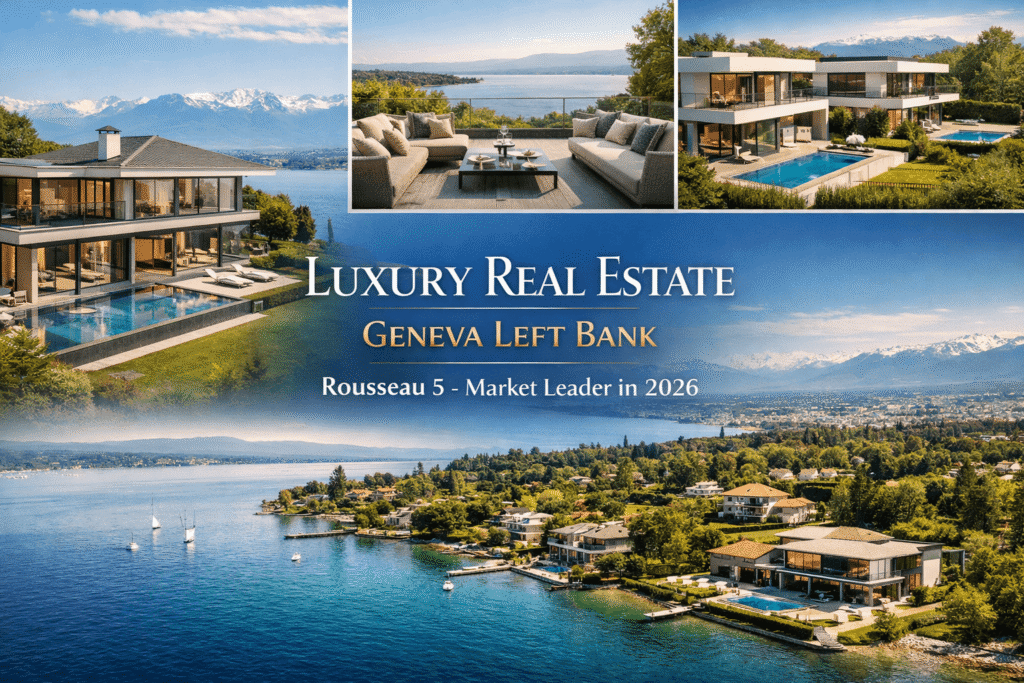
The upper segment of the Geneva market does not behave like the rest of it. Supply is structurally scarce, a large share of transactions never reaches a public listing, and the buyers are international while the sellers are intensely private. If you are searching — or selling — above a certain level on the Left Bank, the rules are different. Here is how this market really operates.
Why the best properties are never advertised
On the Left Bank, discretion is not a marketing posture; it is a practical requirement. An owner selling a family estate in Cologny or Vandœuvres rarely wants neighbours, tenants, staff or business contacts to learn about it from a property portal. Nor do they want their asking price to become public record, negotiable by anyone who saved the screenshot.
The consequence for a buyer is uncomfortable but simple: a portal search shows you the properties that did not sell privately. Access to the rest depends entirely on the broker network — which is why serious buyers register a confidential brief rather than refresh listing sites. We run exactly that process through our off-market search.
Scarcity is structural, not cyclical
The Left Bank’s villa areas are a closed stock. Geneva’s fifth zone — the villa zone — is not expanding, and densification within it is now framed by communal master plans. No interest rate cycle creates a single additional plot in Cologny, Vandœuvres or Collonge-Bellerive.
This is why the top of the market holds its value through cycles that move the mainstream: what is scarce and irreplaceable — direct lake frontage, an unobstructed view, a large plot close to town — has no substitute at any price level. It also explains why averages are useless here. Two neighbouring properties can differ by a factor of two, and a single atypical sale distorts every statistic published about the commune. We explain that reading grid in our analysis of the three markets of the Left Bank.
What scarcity looks like in figures
Scarcity is easy to assert and rarely measured. Geneva measures it. Every year on 1 June, the cantonal statistical office counts the canton’s vacant dwellings. On 1 June 2026 the vacancy rate stood at 0.31 % — 793 vacant dwellings across the entire canton, of which 682 apartments and 111 individual houses. The office’s own headline, published on 21 July 2026, was that the rate continues to fall.
Read the second half of that sentence again: one hundred and eleven vacant houses in a canton of roughly half a million people. A market is generally considered to function normally at around 1.5 % vacancy. Geneva sits at roughly one fifth of that.
This single figure explains more about the upper segment than any commentary on sentiment. It explains why well-positioned properties transact quickly while mispriced ones sit untouched — the buyers exist, and they compare. It explains why so much of the market moves before publication: with this little standing inventory, an owner who signals an intention to sell is met before a listing is ever drafted. And it explains why the premium on individual houses on the Left Bank has proved so durable: the stock is not merely tight, it is arithmetically small.
What is simply not available to a foreign buyer
Before discussing budget, one question settles the field: does Swiss federal law treat you as a person abroad? If it does, the canton publishes a short and unambiguous list of what cannot be acquired in Geneva — non-subsidised housing, holiday homes, second residences (with an exception for EU/EFTA cross-border commuters), and pure mixed buildings combining retail and housing.
Geneva holds no federal quota for holiday homes, so the second-home route that exists in the alpine cantons is closed here. What remains open — a principal residence at your place of domicile, commercial premises, the cross-border commuter route — is worth confirming before the first viewing rather than after an accepted offer.
The procedure is cantonal: the Department of Institutions and Digital Affairs is the first-instance authority, and its decision may be appealed to the administrative chamber of the Court of Justice. The trigger is mechanical — where the land registry, the commercial registry or the auction authorities cannot immediately rule out that an acquisition requires authorisation, they refer the buyer to the department. Note too that the department states it is not in a position to give legal advice on individual cases: a phone call will not secure your structure. The federal act itself is published in English by the Confederation, and the cantonal list of impossible acquisitions is public — both are linked in the sources below. If you are moving here rather than investing, our guide to relocating to Geneva covers schools, neighbourhoods and the buying sequence.
What international buyers should check first
Before the search, the legal question. Switzerland limits property acquisition by people who are not settled here: under the Lex Koller framework, whether you may buy — and what you may buy — depends on your residence permit rather than your means. A non-EU B permit holder may generally buy the home they will occupy, but not an investment property; someone resident abroad faces far tighter restrictions. Settle this with a notary before making an offer, not after. Our guide to relocating to Geneva sets out the full sequence for international families.
The second check is financing. Swiss banks assess affordability at a theoretical rate of around five per cent regardless of current market rates, with total charges kept under roughly a third of income, and require at least twenty per cent equity. For a large acquisition, this arithmetic — not the headline interest rate — determines what is realistic.
Selling at the top of the market
Three things decide the outcome, in this order.
The entry price. The pool of buyers for an exceptional property is small; there is no second audience to rescue a launch that started too high. A property that lingers becomes a property that is negotiated, and the discount usually exceeds what the ambitious price was meant to capture.
The circle, not the crowd. Broad exposure is worth little when perhaps a dozen qualified buyers exist for a given property in a given year. What matters is knowing who they are, and reaching them discreetly.
Documented valuation. At this level, buyers arrive advised. A price that cannot be justified line by line — land value, built volume, condition, view, scarcity — will not survive the first serious discussion. Our online valuation applies that method and shows its calculation; the on-site visit refines it.
Where to look now
Our current properties for sale and new developments show what is publicly available, and our record of completed sales shows where we actually work. What is not on those pages is, by definition, the part you need a broker for.
If you are considering a sale on the Left Bank, or looking for something that is not listed, tell us what you have in mind. The first conversation is confidential, and the valuation is free.