
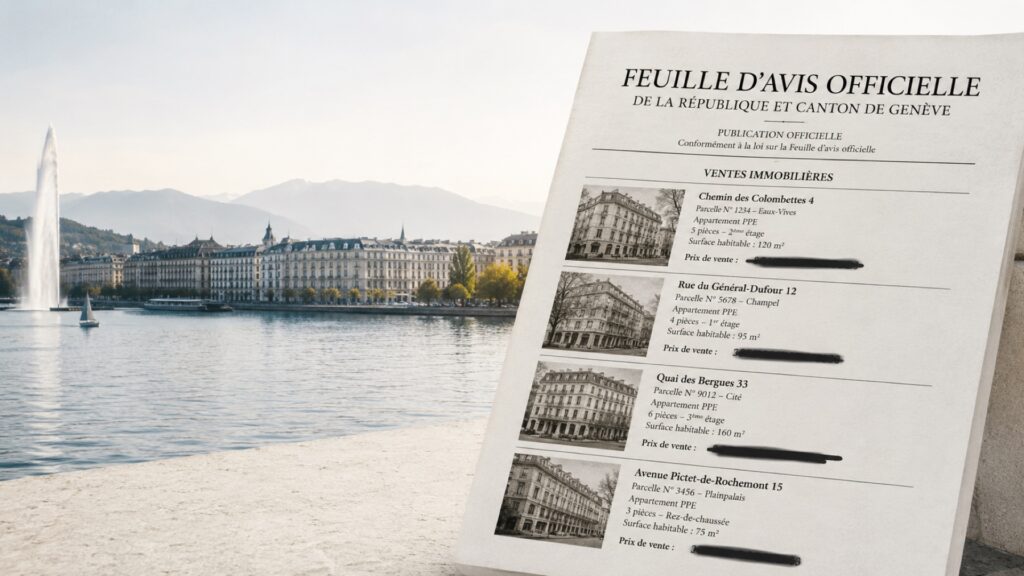
Every Friday for some thirty years, Geneva has published what almost no other property market shows: the actual price of every sale, together with the names of the seller and the buyer. A bill under examination by the Grand Council this month would put an end to it. Before saying what we think of it, let us look at what this transparency gives you in practice, whether you are selling or buying, and what you would lose.
What Geneva has published for thirty years
The principle is simple, and it is Geneva’s own. When a property changes hands, the Land Registry Office publishes the acquisition: the plot, the commune, the price written in the deed, and the identity of the parties. These land publications appear in the Feuille d’avis officielle, the cantonal gazette, and on the canton’s portal, updated as a rule every Friday, freely accessible at no charge. The framework is federal, since the Civil Code allows the cantons to publish acquisitions of real property, and the implementation is cantonal, in the law applying the Civil Code, the LaCC.
This practice was not born of a taste for indiscretion. It was introduced in the wake of the property crisis of the early 1990s, when the canton wanted everyone to see what was being sold, to whom, and at what price. Thirty years on, it has become the raw material of everything serious that is said about the Geneva market: the cantonal statistical office’s figures, press investigations, valuation tools, and the daily work of brokers who have to justify a price to a seller or a buyer.
Bill 13711: what would change
Tabled by twelve members of parliament, mainly from Le Centre and the PLR, led by the lawyer Sébastien Desfayes, bill 13711 amends the LaCC with an aim written into its title: to protect the physical safety of the canton’s residents by no longer publishing, on the FAO website, the amount of sales and the names of the people concerned. Behind the initiative stands Suissenégoce, the umbrella body of commodity traders, after a series of violent burglaries targeting traders living in Geneva.
Referred to the Economy Committee on 20 November 2025, the text returns to the Grand Council this autumn. According to the press, the majority is preparing to vote for it, and a compromise discussed in committee would partly spare the rental market. No date for a vote in plenary session has been announced so far.
The security argument has been examined. Heard by the committee, the Attorney General Olivier Jornot indicated that it did not stand up to the facts: nothing shows that land publications guided the perpetrators of these burglaries. Opponents of the text, the authorities and the left, point out that transparency helps to spot atypical sales, to fight money laundering and speculation, and that an identical attempt had already failed some fifteen years ago after a heated controversy. The debate is legitimate on both sides; it is not the one we want to settle here.
What transparency gives you, if you are selling
A Geneva seller has an advantage few sellers have elsewhere: they can defend their price with facts, not with listings. Listings say what sellers hope for; land publications say what buyers paid. The difference between the two is the whole negotiation.
- You know what your neighbour sold for. Not what they advertised: what they obtained, and when. On the Left Bank, where three markets coexist under one price per square metre, it is the only reliable compass.
- You set a price that holds. A price backed by the recorded sales of your commune, sometimes of your street, is negotiated less because it is disputed less.
- You read the calendar. The number of sales per month, per commune and per type of property tells you when the market absorbs and when it waits.
What it gives you, if you are buying
For a buyer, transparency is a protection. It stops you paying a listing’s price where the market pays another.
- You compare with sales, not with asking prices. The price asked for an apartment in Champel or a villa in Vandœuvres is set against the sales recorded in the same area over recent months.
- You spot the atypical. A sale far above or far below its neighbours shows. It has a reason, whether condition, view, location or rarity, and that reason is worth asking about before you sign.
- You negotiate on figures. An offer argued with three comparable sales carries more weight than one argued with a feeling.
Without the publication of prices, all of this would remain possible for professionals with access to the registry, and would become much harder for you.
What would not change: the official statistics
One point deserves to be said clearly, because it is reassuring. The figures of the Cantonal Statistical Office, OCSTAT, do not depend on the Feuille d’avis officielle: OCSTAT draws its numbers from the land registry itself. Number of sales, median prices of single-family houses, price per square metre of condominium apartments, by commune and by district of the city of Geneva, since 1990: this series would go on being published every year, whatever becomes of the bill.
What would disappear is the fine grain: the precise sale, at a given address, at a given price, in a given week. What would remain is the overall reading: medians, quartiles, the evolution of a commune over ten or thirty years. The two complement each other, and that is exactly what we have built.
What Rousseau 5 offers you, and will keep feeding
We have made transparency a method, not a slogan. On this site you will find today:
- The recorded sales of the Left Bank, on a map and in tables updated continuously: commune, type of property, plot, price, date. Every point is a real sale, never a listing.
- The official history since 1990, commune by commune and district by district, from the OCSTAT tables: how many sales, at what median price, with what quartiles, and how all of it has moved. The same figures feed each of our commune pages.
- A valuation anchored in those sales, not in an average of listings: our online valuation cites the neighbourhood grid and the OCSTAT benchmark for your commune, line by line, before a broker refines it on site.
- An audit of your listing if your property is not selling, which sets your price against the official bounds of the market: the confidential audit.
Whatever the Grand Council decides, we will keep feeding these tools with what remains public, the official statistics first, so that our visitors, sellers and buyers alike, understand the market and take their decisions on facts. That is how we have practised this profession in Geneva since 2012.
What to do now, if you are selling or buying
- Look at what really sold near you, while the publication is still complete: the transactions map shows you in a few seconds.
- Have your property valued on those sales, not on listings: online valuation, then on site.
- If your property is already on the market and not moving, the confidential audit reads your listing, its photos and its price against the recorded sales.
We will update this article as soon as the Grand Council has decided.