
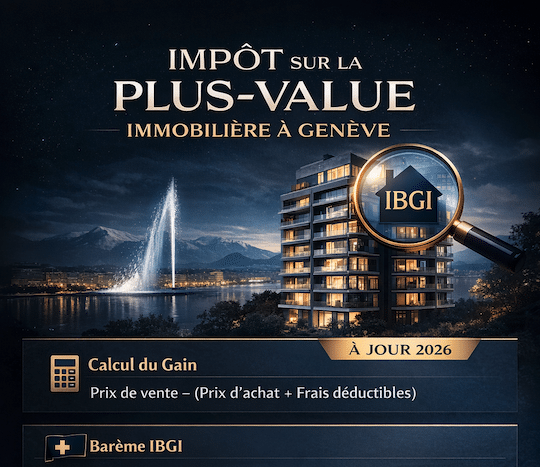
Selling a property at a profit in Geneva triggers the tax on real estate profits and gains — the IBGI. Its rate depends on only one thing: the length of time you have held the property. From 50% of the gain before two years to 2% after twenty-five years, the gap is such that the sale date is often the seller’s first tax decision.
What the IBGI is
A cantonal tax on the profit from the sale — not on the price. It applies to the difference between what you receive and what the property cost you, and it applies regardless of your tax residence: a seller domiciled outside the canton, or outside Switzerland, owes it too. Every sale must in fact be the subject of an IBGI declaration, even without a gain.
How the taxable gain is calculated
The gain is not simply the difference between the sale price and the purchase price. Deductible items include:
- the original acquisition costs — notary fees and registration duties;
- work that increased the value of the property (capital improvements), as distinct from ordinary maintenance;
- the brokerage fee paid for the sale.
And what is not deductible is half the story: maintenance costs do not count, whether or not they were deducted from your ordinary income. Repainting, replacing a boiler with an identical one, redoing a joint: maintenance. Adding a bathroom, insulating what wasn’t insulated, converting an attic: value-adding improvement. It is this boundary that decides, not the amount of the invoice.
Keeping proof of work carried out over the entire holding period is therefore not administrative fussiness: every invoice found reduces the taxable gain, and a lost invoice cannot be recovered.
The 2026 scale, by holding period
| Holding period | Rate on the gain |
|---|---|
| Less than 2 years | 50% |
| 2 to 4 years | 40% |
| 4 to 6 years | 30% |
| 6 to 8 years | 20% |
| 8 to 10 years | 15% |
| 10 to 25 years | 10% |
| 25 years or more | 2% (floor rate) |
The 2% floor is new for 2025: previously, holding beyond twenty-five years fully exempted the gain. This is no longer the case — even very long-standing owners now pay something.
An inherited property: the clock does not reset to zero
This is the point that changes everything for a family, and the one we most often see misunderstood. An heir who sells a house received eight months ago is not considered by the Geneva tax authorities to have held the property for eight months: the holding period carries over from the deceased, counted from the date on which THEY acquired the property. The rule applies to estates opened since 1 January 2001; for older ones, the period starts from the date of death.
Same mechanism for a gift: the period starts from the donor’s original acquisition. A villa bought by the parents in 1988 and gifted to the children in 2024 is therefore sold at the floor rate, not at 50%.
The practical consequence can be summed up in one sentence: before selling a property you received, look for the original acquisition date — it appears in the land registry, and it is often worth more than any price negotiation.
Two worked examples
Short holding period. Purchase of 1’000’000 francs in 2023, resale at 1’300’000 francs in 2024: gain of 300’000 francs, holding period under two years, rate of 50% — 150’000 francs in tax. Half the gain goes to the State: that is the price of a quick resale.
Long holding period. Purchase of 800’000 francs in 1990, sale at 1’200’000 francs in 2026: gain of 400’000 francs, more than twenty-five years, floor rate of 2% — 8’000 francs in tax.
Similar orders of magnitude for the gain, but tax eighteen times lighter: the holding period makes all the difference.
Reducing or deferring the tax
Three levers, all legal and provided for by law:
- Holding period — when the sale can wait for a change of bracket, a few months can sometimes be worth tens of thousands of francs;
- deductions — documented capital improvements, acquisition costs, brokerage fee;
- reinvestment (remploi) — selling your main residence and buying again in Switzerland within five years allows the tax to be deferred; the full mechanism is detailed in our article on reinvestment.
Private management or professional activity
The scale above applies to private wealth. An activity deemed professional — repeated purchase-resale operations, speculative transactions — is subject to separate, heavier rules. The boundary is assessed case by case, and it is a matter to address before multiplying transactions, not after.
In practice, for your sale
The IBGI is recorded with the notary at the time of sale: it is deducted from the proceeds before they reach you. And since the tax is calculated on the gain, everything starts with the price: a valuation based on actual transactions sets the basis for it — the net amount, meanwhile, works out lower. The terms used in this article are defined in the glossary.
What is decided, and when
Three dates govern the IBGI, and none of them is the day of signing. The acquisition date — that of the deceased or the donor, where applicable — sets the starting point. Holding anniversaries trigger a change of bracket: between the 23rd and 25th month, the rate drops from 50% to 40%, and this is calculated down to the week. Finally, the date of the deed stops the clock.
Calculating your IBGI
The scale above can be applied to your situation in two minutes, along with the rest of the calculation — because the IBGI is never the only line between the advertised price and what reaches your account. The net seller proceeds simulator applies the Geneva scale to your holding period, deducts the capital improvements you enter, subtracts the mortgage to be repaid and the costs, and displays the net amount.
It gives an order of magnitude, not a statement: whether value-adding work is eligible depends on supporting documents, and a situation deemed professional falls outside the scale. For a figure that is binding, you need a notary or a tax specialist — but to decide whether to sell now or wait for the next threshold, it is more than enough.