
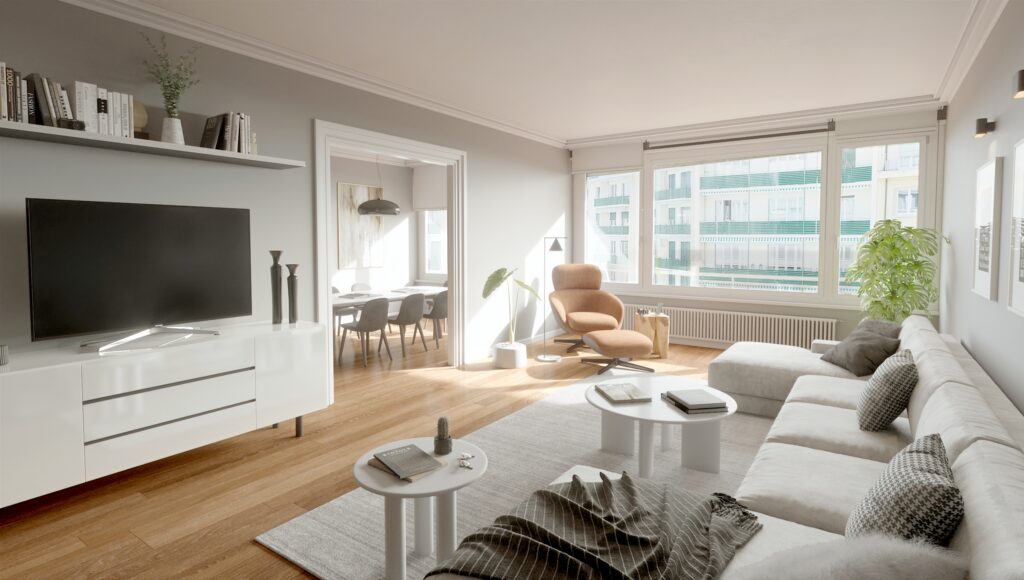
A Geneva buyer views few properties, but compares them all — and the first viewing takes place on their screen, photo by photo, long before the front door. Home staging plays exactly there: presenting the property in its best real light, without major works and without disguise. Here is what the method really changes, what it must never do, and the cases where it isn’t the right answer.
What home staging is — and isn’t
Born in the United States, “staging” a property means preparing it for sale: depersonalising it, so the visitor can picture themselves there instead of visiting your home; decluttering, to give the rooms back their volumes; fixing the small things, because a loose handle casts doubt on everything else. It is neither a renovation nor interior decoration: you do not transform the property, you remove what prevents people from seeing it.
Why it matters particularly in Geneva
In a market where prices are high, the buyer is demanding: at this level of commitment, the slightest sign of neglect is paid for in negotiation. And since the first impression is made in photos, a property prepared before the photo shoot starts with a head start over all its online competition — then confirms this during the viewing, where the cleared volumes and light do the work. Staging does not create value: it prevents it from being lost.
The five gestures that change a viewing
- Decluttering and depersonalising — family photos, collections, surplus furniture: everything that tells your life story prevents the buyer from imagining their own;
- thorough cleaning — floors, grout, windows: cleanliness is the first trust signal of a viewing, and the cheapest one;
- fixing the small things — a dead bulb, a dripping tap, a wall to freshen up: every visible micro-defect becomes a negotiating point;
- revealing light and volumes — curtains open, passageways cleared, smooth flow from one room to another;
- harmonising — a few staging touches are enough: a bed made with precision, a table set simply, calm tones.
The red line: enhancing is not concealing
Home staging highlights what exists; it hides nothing. Concealing a leak behind a cupboard or repainting to hide damp is not staging — it is a fraudulently concealed defect, and Swiss law catches up with it: the warranty for defects can never be excluded in the event of fraud, and the sale can end up being contested years after signing. A known defect is disclosed and reflected in the price; this is also what protects the seller.
What the law really says — and why it protects the seller
Almost all property sale deeds in Switzerland include a warranty exclusion clause: the seller is not liable for defects. It looks reassuring, and many sellers rely on it without reading it. Yet Article 199 of the Code of Obligations strips it of effect in one specific case: any clause that removes or limits the warranty is void if the seller fraudulently concealed the defects. A cupboard placed in front of a trace of infiltration, a coat of paint over known damp: the clause falls away, and the sale can be contested years later.
The nuance, rarely mentioned, works the other way: the burden of proof lies with the buyer, and it is hard to meet. This is not an invitation to conceal — it is the reason why a dispute of this kind drags on for years, at both parties’ expense, with no one gaining from it.
Hence the only strategy that truly protects a seller, and it costs nothing: declare in writing what you know. A document appended to the deed, listing known defects — the 2019 infiltration and its repair, the crack being monitored, the boiler nearing the end of its life — turns a risk into information. A disclosed defect is negotiated into the price; an undisclosed defect ends up argued in court. And a buyer who signed with full knowledge of the facts can no longer invoke it.
Home staging sits comfortably with this rule: it reveals what exists. That is even its definition. What you don’t want to show must be disclosed — not hidden behind a piece of furniture.
When staging isn’t the right answer
A property requiring a full renovation gains nothing from staging: its buyer is a buyer of potential, who wants to see the walls, not the furniture. Similarly, certain exceptional properties sell better off-market, discreetly, without any public photo shoot at all. It is the valuation that settles the strategy: it states what the property is worth today, what each scenario can change, and where to spend — or not spend — every last franc.
How we integrate it into the sale
At Rousseau 5, staging is not an optional extra: it is a step in the sales method, between the valuation and going to market. We review the property room by room, decide together on the useful gestures — and only those — then the photo shoot fixes the result. Everything begins with a confidential audit of your property, with no obligation; and once viewings begin, the preparation pays off at the decisive moment: when it comes to defending your price. To measure the stakes in francs, the net seller proceeds simulator calculates what the sale actually leaves you. Technical terms are in the glossary.