
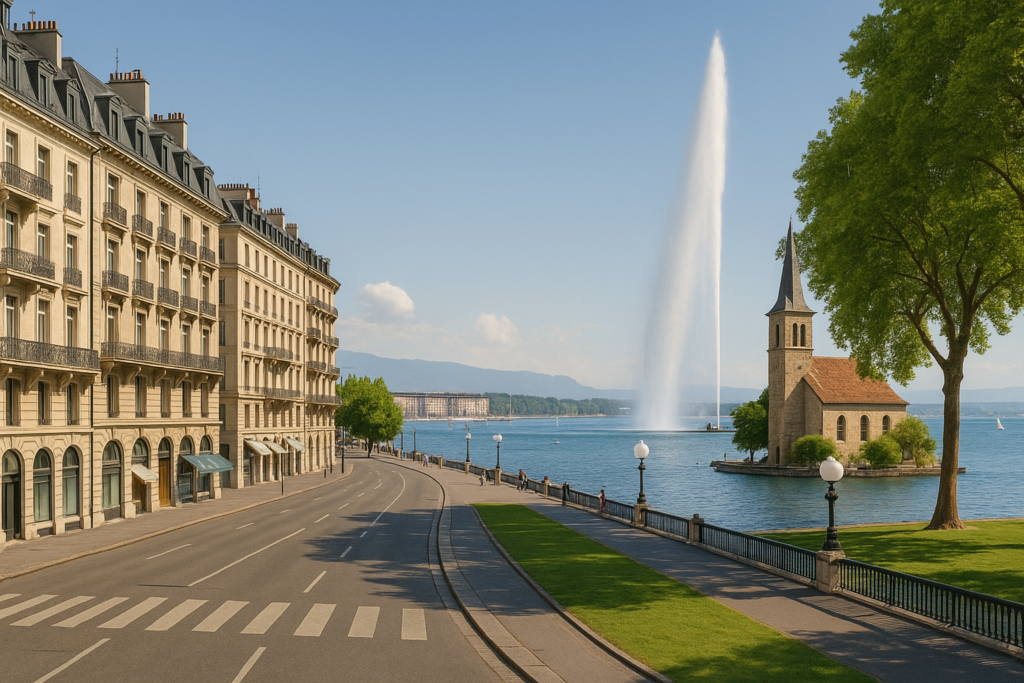
A former independent commune attached to the city in 1931, Eaux-Vives is the Geneva neighbourhood that has changed the most in recent years: the arrival of the Léman Express and the transformation of the station have remade it into a hub. Between the lake and the parks, it is now one of the most sought-after urban markets on the Left Bank. Here is its structure — and where to read the sales actually signed.
A neighbourhood, two faces
On the lake side: the port, the quays, the urban beaches and the two large parks — La Grange with its famous garden, and Parc des Eaux-Vives — which give the neighbourhood a breathing space that the city centre envies. On the city side: Rue des Eaux-Vives with its continuous run of shops, the early-twentieth-century rental buildings, and dense neighbourhood life. Property values follow this geography: high-standing older buildings near the parks and the lake at the top, the more accessible shopping heart, and the new station hub in between.
The Léman Express effect
Eaux-Vives station, integrated into the Léman Express network, has done more than shorten journeys: it has re-centred the neighbourhood. Around it, mixed-use developments — housing, offices, shops, as seen in the O’Vives complex — have brought new-build stock to an urban fabric that had stopped producing any. For the market, the effect is twofold: broader demand — cross-border commuters using the network, young urban households — and a lasting premium on addresses close to the station, the classic phenomenon of successful station neighbourhoods.
What drives prices in Eaux-Vives
One figure says everything essential about this market: among the Eaux-Vives sales recorded this year in the land register, not a single house. The neighbourhood sells only flats — the only one of our Left Bank areas where this is the case, and that says more than any commentary on its density. The up-to-date count can be read on our neighbourhood page, which updates as the register publishes.
A market of flats par excellence, the neighbourhood is ranked by proximity to the lake and the parks — value decreases as you move away from the quays —, by floor and view — a penthouse with a view over the harbour joins the luxury segment —, by the character of renovated older buildings, and by actual weighted floor area, with balconies counted at their weighting. With many buildings remaining rental stock, PPE (condominium) sales are proportionally rare here — a tension factor that supports the neighbourhood’s prices, and a context in which selling a let property follows its own rules.
Why so few flats are sold: article 39
The scarcity of PPE sales in Eaux-Vives is not a market accident, it is a rule of law. Article 39 of the law on demolitions, alterations and renovations — the LDTR — requires authorisation for the sale of a let flat, or one that has been offered for rent, whenever it falls, by its rent or by its type, into the category affected by the shortage. In Geneva, this category covers most of the ordinary urban housing stock.
In other words: an owner of a rental building in the neighbourhood does not decide alone to sell its flats one by one. Authorisation must be requested, and it is assessed by weighing the seller’s private interest against the public interest in maintaining rental housing stock.
The law names the cases where the private interest is presumed to prevail, and they are worth knowing:
- the buyer is the sitting tenant, who has occupied the home for at least three years, with the agreement of 60% of the building’s tenants, and a guarantee for the others that they will neither have to buy nor to leave;
- the owner must sell to settle a matrimonial property regime or an estate;
- he must sell to meet a debt-repayment plan;
- he is taking up residence outside the canton.
Three consequences for anyone buying or selling here. First, the supply of vacant flats for sale is structurally constrained — which supports the prices of what does sell. Second, an occupied property and a vacant property are not the same product: they have neither the same buyer, nor the same price, nor the same timetable. Finally, the question arises before the exchange of contracts, not at the time of the deed: the process is conducted with the notary, and our article on selling a let property sets out the steps in detail.
Living in Eaux-Vives
The neighbourhood’s daily life explains its demand: the quays for running or strolling facing the harbour and the Jet d’Eau, the urban beaches and the port for fine days, La Grange garden and its rose garden for Sundays, and a shopping street that lives from morning to evening — grocers, cafés, restaurants, craftspeople. The neighbourhood’s schools and its immediate proximity to the centre make it a natural choice for urban families as well as for professionals who want to do everything on foot. This completeness — lake, parks, shops, station — is rare in Geneva: it is this that the market pays for, address by address.
Real prices, live
Quays, parks, station or shopping heart: two neighbouring buildings can belong to two different worlds — all the more reason to read the sales rather than the averages. Our Eaux-Vives page brings together the neighbourhood’s recorded transactions; the transactions map sets them against the rest of the city; and “how much did your neighbour sell for” searches building by building.
Buying or selling in Eaux-Vives
For buyers: the scarcity of PPE means good opportunities move fast, often before the listing goes public — have your file ready, decide quickly. For sellers: the neighbourhood rewards prices built on sales in the specific micro-area — quays, parks, station, shopping heart are not equivalent — with an on-site valuation. The canton’s overall structure can be read in our analysis of the Geneva market; every technical term, in the glossary.