
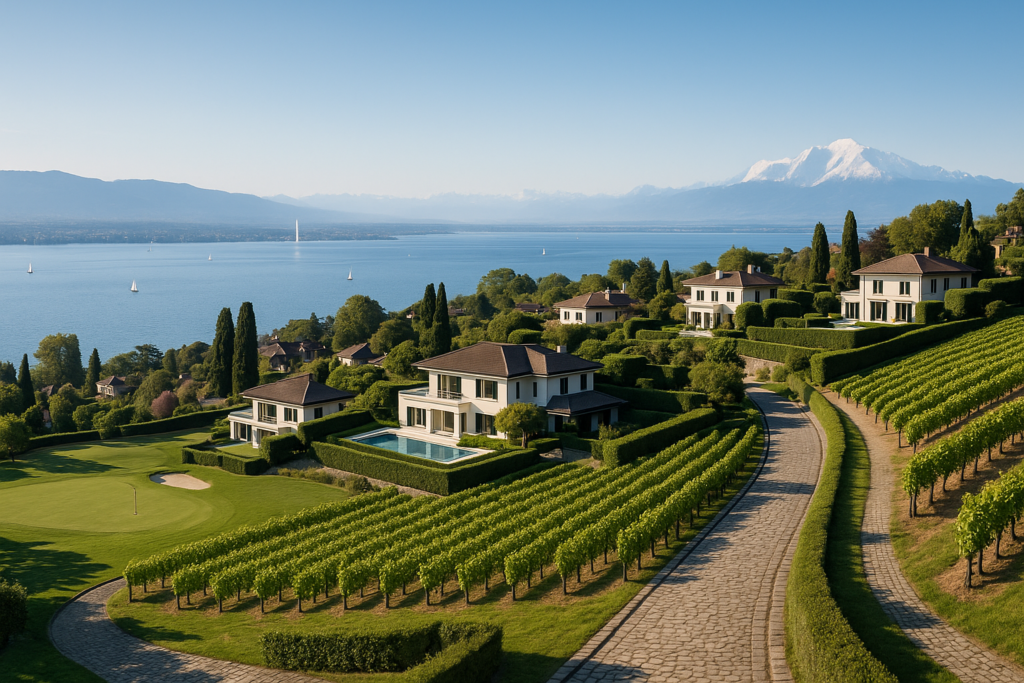
Cologny is the name the Geneva market gives to the word “prestige” — and, according to the UBS study, the highest average price of the luxury segment in Switzerland outside mountain resorts. But behind the reputation lies a specific geography and set of rules. Here is what actually drives prices in the commune, and where to read the sales that have been signed.
Geography makes the market
It all starts with the topography: a hillside facing due west, which gives a large share of the residences a triple view — lake, Jura, and sunsets over the bay. This view is not an amenity, it is the local unit of account: for equivalent buildings, a plot overlooking the lake and one that does not belong to two different markets. Add to this the paths between properties, the woods and vineyards overlooking the lake, and the Golf Club de Genève — one of the most prestigious courses in the country — which anchors the commune’s way of life.
What drives prices in Cologny
In order: the plot — area, orientation, privacy, remaining building rights; the view, and how lasting it is — an unobstructed view protected by the topography is worth more than a view exposed to neighbouring construction; the building, lastly — the gap between an impeccable contemporary villa and a property that needs updating runs into millions, and international buyers, who compare against the whole world, notice it immediately. Published average prices per m² lump these worlds together: our analysis of the UBS figures explains why they mislead — and what to read instead.
What your plot allows: the real question in the villa zone
In Cologny, people talk about plot size and lake views. They rarely talk about the figure that nonetheless decides part of the value: the land use index. The commune falls essentially within zone 5, the villa zone, whose ordinary regime comes down to two numbers — a maximum height of 10 metres and a standard land use index of 0.25. On a plot of 1’200 m², this allows for roughly 300 m² of floor space.
But since 2013, this ceiling is no longer a wall. Article 59 of the Construction Act allows densification beyond 0.25 on an exceptional basis: the index can rise towards 0.4 when the project fits in with the neighbourhood, and up to 0.6 on very large plots meeting the highest energy standard. The HPE and THPE standards themselves allow for an increase in the index of 10 and 20%.
There are two very concrete consequences for anyone buying or selling here. First, two neighbouring plots of the same size are not worth the same if one can support a dense project and the other cannot — this is the difference between a residential plot and a plot with potential, and it runs into millions on this market. Second, the exception is not a right: it is assessed on a case-by-case basis, and communes designate, in their municipal master plan, the areas where densification is encouraged. The rule evolves, and it is the commune’s plan that decides.
Before setting a price — whether buying or selling — the question is therefore not only “how many square metres” but “what does this particular plot allow”. It is raised with the planning department and prepared through plot due diligence; our article on building land explains how building rights are calculated.
Real prices, live
The commune’s registered sales can be viewed on our Cologny page; the transactions map shows their place within the canton; and “how much did your neighbour sell for” finds those for a given address. In a market where a handful of transactions make the year, this plot-by-plot reading is the only one that counts.
The village, the quay, the legend
Cologny is not just a collection of properties: it is a village, with its square, its restaurants and its communal life — five minutes from the bay. The quai de Cologny offers one of the most popular walks in the canton, and the Byron meadow recalls that the commune has its own legend: it was at Villa Diodati, above the lake, that Lord Byron and Mary Shelley spent the summer of 1816 — the summer that gave rise to “Frankenstein”. This extra dimension is not incidental to the market: addresses that carry a story are passed down, cited, and support the value of everything around them. In Cologny, you do not just buy a view — you buy an address that the whole world can place.
Who buys in Cologny
Wealthy Swiss individuals seeking discretion, international buyers settled in Switzerland — LFAIE status is checked before any viewing —, entrepreneurs and family offices: the circle is narrow, demanding, and largely off-market — a significant share of the commune’s sales never appear in listings. For a buyer, being recognised within this circle is the real key; our guide to buying a villa in Cologny sets out the full process.
Selling in Cologny
A Cologny property is not sold like any other: pricing built plot by plot — never on the average —, valuation for the exceptional segment, discretion by default, and the top-of-market method: a qualified circle, off-market first, selective distribution. The entry price is more decisive here than anywhere else: the audience for an exceptional property is too limited to give a second chance to a failed launch. The overall framework is set out in our analysis of the Geneva market — and terms are explained in the glossary.