
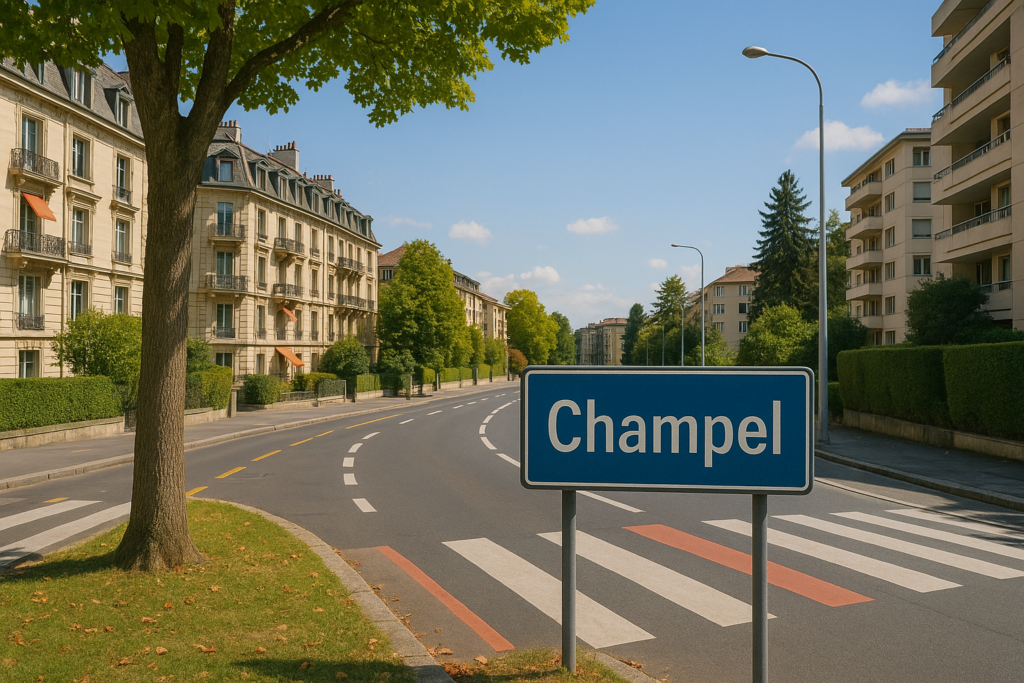
Champel is the quintessential residential district of the City of Geneva: tree-lined avenues, bourgeois apartment buildings, and that rare combination of park-like calm and a city centre just minutes away. On the urban Left Bank, this is the market for high-end apartments — and one of the deepest in the canton in terms of demand. Here is what shapes its prices, who buys here, and where to find the actual sales.
The setting: parks, cliffs, a train
The Bertrand Park — eleven hectares of urban oasis — gives the district its green lung and its identity; the Champel Tower and the cliffs overlooking the Arve give it its picturesque character. The architecture blends early-twentieth-century bourgeois buildings, comfortable post-war residences and contemporary developments. And since 2019, the Genève-Champel station on the Léman Express has changed the mobility picture: the district is now connected to the regional network without a car — an argument that carries weight, viewing after viewing.
What shapes prices in Champel
An apartment market above all, Champel is ranked by four factors: the address — the park side, the Arve side and the heart of the district are not equivalent; the floor and the view — penthouses with panoramic views of the Salève or the city form the top of the market; character — renovated high-end older buildings, with mouldings and generous volumes, retain a constant premium; and actual weighted floor area, with balconies and terraces counted at their proper weight — our guide to the calculation explains why two “identical” listings are never quite alike. From one building to the next, the condition of the PPE (condominium) — service charges, renovation fund — accounts for the rest.
Champel does not exist in the land registry
The statement is provocative, but it is accurate. The Geneva land registry publishes its transactions by municipality and cadastral section. Champel is neither: it is a district of the City of Geneva, and its sales are recorded under the section “Genève-Plainpalais”, alongside areas that share neither its buildings, nor its parks, nor its prices.
Search for “sale prices in Champel” in the public data: you will find nothing. You will find City of Geneva averages — a whole in which Champel carries little weight and is diluted — or averages of listings, which are not prices but asking amounts. Neither will tell you what a penthouse on chemin Rieu actually sold for.
We got around this obstacle by the only practicable route: the property’s postcode, which appears in the text of the published deed. 1206 identifies Champel and Florissant; it is not to be confused with 1205 for Plainpalais, nor with 1207 for Eaux-Vives. The reliability of the method was checked against one hundred and fifty-three sales in unambiguous municipalities: one hundred and fifty-two matches.
Each sale then counts twice, and this is deliberate: once for Champel, once for the City of Geneva. A district is within its municipality; it is not subtracted from it. The result: Champel’s sales finally appear under their own name on our district page and on the transactions map. If you are selling here, it is this list — not the City average — that should serve as the reference for your price.
A corollary is worth noting, because it works in your favour: online valuation engines inherit the same blind spot. They learn from data aggregated by municipality, where Champel does not exist — their figure for a penthouse on the plateau is therefore calibrated on a City of Geneva that includes unrelated areas. The gap is not a matter of a few percentage points.
Real prices, live
Published averages mix studios and penthouses, older and new-build properties — they mislead more than they inform. Our Champel page brings together the district’s recorded transactions; the transactions map sets it alongside other high-end districts; and “how much did your neighbour sell for” finds what was signed on your street — on the park side or the Arve side. For the top of the segment, our analysis of the top of the market deciphers luxury averages and their pitfalls.
Who buys — and who rents
Demand in Champel is threefold: Geneva families drawn by the schools, the parks and the nearby university; international professionals — from organisations, multinationals, medicine around the HUG — who buy or rent long-term; and investors, precisely because this rental demand is among the most reliable in the canton. For a landlord, this depth is an asset — and on the day of sale, an ongoing lease is managed according to Geneva rules: our guide to selling a let property covers the details.
Champel within the city: a status apart
Administratively, Champel is not a municipality but a district of the City of Geneva — so taxation and communal services are those of the City. This detail has concrete effects: the City’s additional communal tax rate applies, and the market is primarily compared to other high-end urban districts — Florissant, Malagnou, Eaux-Vives — rather than to villa municipalities. Within this urban family, Champel plays the role of a core-holding district: one bought for decades, whose demand does not falter in any cycle, and whose supply — constrained by an already-built environment — cannot expand. New developments here are rare and take the form of additional storeys or occasional rebuilds; each one finds a buyer before construction is even finished.
Buying or selling in Champel
For buyers: fine properties move quickly, often before they are listed — having financing ready and a clearly defined search area make the difference. For sellers: a Champel apartment deserves a price built on the actual sales in its micro-area, not on the district average — that is the purpose of an on-site valuation. To place Champel within the structure of the canton, our analysis of the Geneva market provides the framework — and technical terms are in the glossary.