
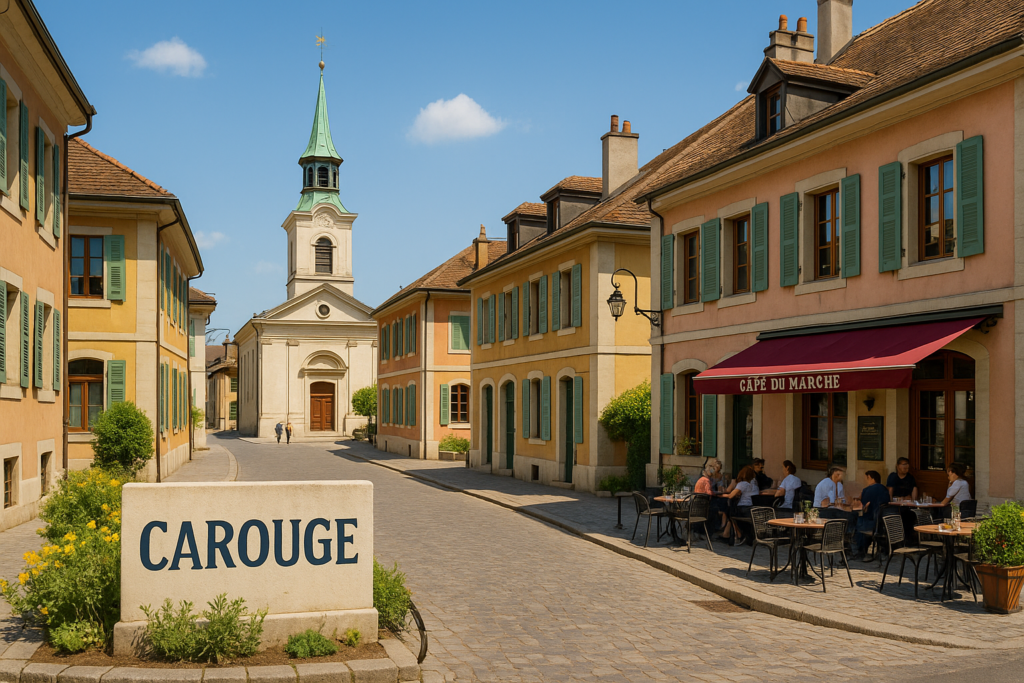
Carouge is not a district of Geneva: it is a city in its own right, Sardinian in origin, laid out in the 18th century by Piedmontese architects — and its property market has the character of its history. Cobbled lanes, neoclassical façades, shaded squares: the “Sardinian city” offers a Mediterranean way of life unique in Switzerland, and a market as distinctive as its setting. Here is its structure.
Vieux-Carouge: heritage that drives prices
The historic heart — Vieux-Carouge — is a unique case in the canton: low buildings from the Sardinian era, inner courtyards, artisans’ arcades, a protected heritage that prevents any standardisation. Flats here are sought after for what no new development can offer — character — and their scarcity is absolute: the historic perimeter has not a single metre to spare. Around it, Carouge covers every register: 20th-century rental buildings, residential complexes, and the new districts rising towards Praille and the Carouge towers.
What drives prices in Carouge
Three factors dominate: location — Vieux-Carouge and its immediate surroundings carry a constant character premium, while the more recent sectors play on modernity and specifications; the floor, outdoor space and condition, as everywhere in the city, weighted by the weighted surface area; and neighbourhood life itself — markets, workshops, cafés, theatres — which makes Carouge a deliberate choice: you don’t live here by default, you choose to live here. As part of the stock remains rented, selling a let property here follows the usual Geneva rules.
The real prices, live
Three hundred metres separate the Sardinian era from the contemporary towers — hence the importance of reading the sales in YOUR area. Our Carouge page compiles the recorded transactions for the municipality; the transactions map shows the contrast with the city and the countryside; and “what your neighbour sold for” identifies the signatures of your area — Sardinian, residential or recent.
The heritage of Vieux-Carouge is not decoration: it is a legal regime
People readily speak of the “charm” of the Sardinian city. It is worth knowing what that charm entails when you buy. The protected perimeter of Vieux-Carouge is listed on the federal inventory of sites of national importance to be protected — the ISOS — where it is classified as a site of exceptional value. It is also covered by a cantonal site plan, which can be consulted on the SITG like any other plot restriction.
What this means, in practical terms, for an owner:
- a listed building cannot be demolished, altered, or have its use changed without authorisation from the Conseil d’État — and the requirement extends down to routine maintenance work, which always comes as a surprise;
- works of secondary importance, needed for conservation, fall instead under the competent department: the procedure exists, it is simply longer than elsewhere;
- the architecture — volume, scale, materials, colour — must be in keeping with the character of Vieux-Carouge. A window, a façade colour, a dormer cannot be decided on your own.
None of this is a drawback: it is precisely what guarantees that the setting will be the same in thirty years, and therefore that the scarcity will hold. But this must be checked before making an offer, not after: the level of protection of a building can be requested from the cantonal heritage and sites office, and read on the heritage layers of the SITG. A buyer planning to open up a kitchen or convert an attic would do well to know their building’s status before signing — this is one of the points covered by plot due diligence.
Praille-Acacias-Vernets: the neighbour that changes everything
At Carouge’s doorstep lies the largest urban project in French-speaking Switzerland: the transformation of the Praille-Acacias-Vernets sector, set to turn industrial wasteland into housing and business districts over the coming decades. For Carouge, the effect is twofold: an urban stitching that brings the Sardinian city even closer to the heart of the conurbation, and a gradual influx of new residents that strengthens demand for everything that makes Carouge unique — its historic centre first and foremost. The construction phases will change the landscape; the scarcity of Vieux-Carouge, however, will not change.
Who buys in Carouge
A population that chooses: creative urbanites and professionals drawn to the bohemian atmosphere, families attracted by the human scale, the schools and the nearby Arve, investors betting on solid rental demand — Carouge is one of the most sought-after addresses among young Geneva professionals. This rare diversity of demand smooths out cycles: when one segment slows, another takes over. The Saturday market on the square, the theatres, the open workshops and the terraces make up a daily life that acts as a selling point in itself — few Geneva municipalities can say the same.
Carouge is a municipality, not a district — and this is paid for every year
This reminder has tax consequences that buyers coming from the City of Geneva sometimes discover after the fact. Each Geneva municipality sets its own additional cent rate: a surcharge applied to every franc of cantonal tax. Two households with identical incomes therefore do not pay the same amount depending on the municipality where they settle, and the gap between the canton’s municipalities is far from trivial over a lifetime of ownership.
This is not an argument for or against Carouge — it is a factor to be aware of, on the same footing as condominium charges. It takes a minute to check: the State publishes each municipality’s rate, year by year. Look at the rate for the municipality you are leaving and the one for the municipality you are moving to, before comparing two properties that seem similarly priced.
Buying or selling in Carouge
For buyers: in Vieux-Carouge, scarcity rules — fine character properties go quickly, sometimes before they are even listed. For sellers: the price is built on the real sales in the micro-area — Sardinian, residential or recent — with an on-site valuation that weighs character at its true worth. The overall picture is in our analysis of the Geneva market — and every technical term is in the glossary.