
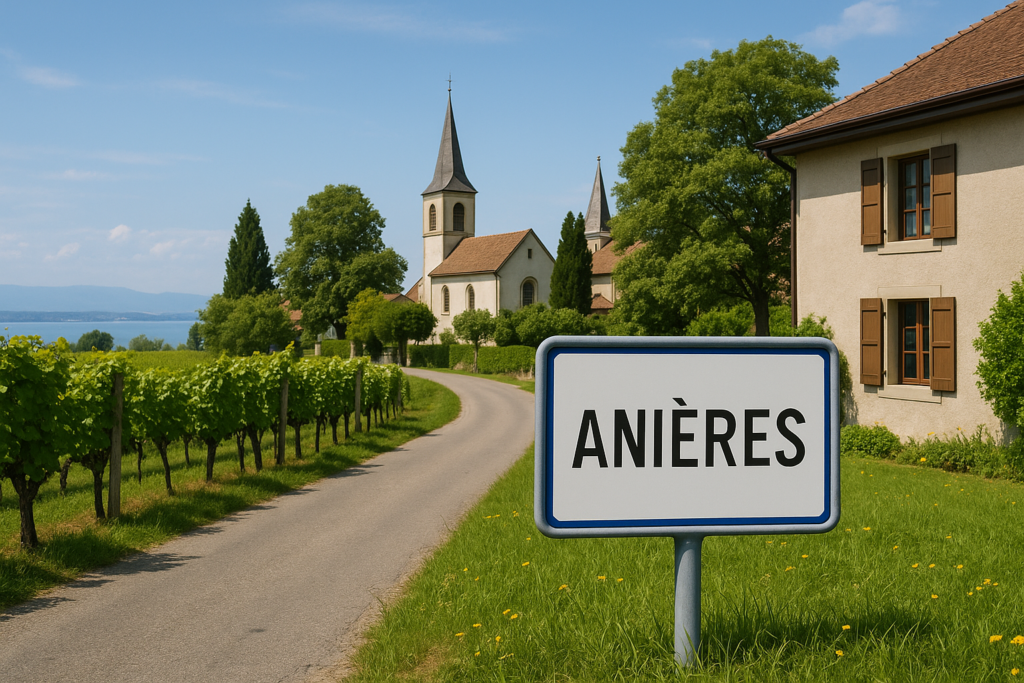
Some ten kilometres from the centre, on the road running along the lake towards Hermance, Anières is one of the most unspoilt villages on the Left Bank — and one of its most exclusive markets: few properties, almost no turnover, and demand that waits. Here is what structures prices in the commune, and where to read the sales that are actually signed.
A village, hamlets, the lake
Anières has kept its scale: a village heart, the hamlets of Chevrens and Bassy up on the hillside — sought after for their charm and their views —, the vineyards, and the shore of Lake Geneva. It is within this tight geography that the whole hierarchy plays out: properties right on the lakeshore, extremely rare, form a category of their own that joins the Geneva exceptional segment; villas on the hillside are ranked by view and plot; the village and the hamlets offer the character houses that families fight over.
A market of scarce supply
The commune is small, zoning is protective, and owners sell rarely: in Anières, it is supply that makes the market. Year after year sees a handful of transactions, and every correctly positioned property finds its buyer — local, Geneva-based, international. The practical consequence: averages mean nothing here — a single sale shifts the statistics — and a notable share of transactions are concluded off-market, among insiders of the sector.
Living in Anières
Daily life in Anières is that of a village that works: a communal school, a dense associative life, the CGN landing stage that links the shore in season, vineyards climbing behind the houses and swimming at the end of the lane. The lakeside road leads to central Geneva in about twenty minutes, and Vésenaz — shops, services — is halfway there. This setting attracts people who come to stay: in Anières, one does not pass through, one settles — and it is precisely this loyalty among residents that creates the chronic scarcity of supply.
Here, scarcity is physical — not legal
A difference of nature sets Anières apart from the urban districts of the Left Bank, and it explains almost everything about its market.
In the city, supply is constrained by law: the law on demolitions, alterations and renovations makes the sale of a let flat falling into the shortage category subject to authorisation, and a notable share of Geneva transfers go through this regime. In Anières, this mechanism practically does not apply: registered sales here are ordinary sales, with no authorisation to sell required.
The scarcity of Anières is of a different nature: it is physical and territorial. The buildable perimeter is set by the zoning plan, the agricultural zone closes off the surroundings, the lake closes off the rest, and the commune produces only a tiny number of new homes. This is not an administrative constraint that can be lifted case by case: it is a finite stock.
Two consequences for anyone buying or selling here. For the seller, the timetable is freer than in the city — no prior procedure conditions the sale —, but the pool of buyers for a given property is narrow: the entry price matters more than anywhere else. For the buyer, there is no hidden reserve that will one day be released: what appears on the market is what exists, and most of it is handled discreetly, off-market, before any publication.
Symmetrically, demand also has its own lock. A commune on the lakeshore naturally attracts buyers from elsewhere — and this is where the Lex Koller comes in: acquisition of a home by a person domiciled abroad is heavily restricted, and it is not budget that decides but residence status. A buyer who discovers the rule after making an offer loses both the property and their time; our article on LFAIE sets out who can buy what, and the notary confirms the situation before any offer is made.
Real prices, live
With a handful of sales a year, every figure is precious. Our Anières page keeps the commune’s registered sales; the transactions map widens the comparison to the villages of the chain — often the only relevant basis; and “how much did your neighbour sell for” unearths what was signed between the village and the hamlets.
Who buys in Anières
Families seeking a genuine village within reasonable distance of the city; lake lovers for whom the shore is the project of a lifetime; and, at the top end of the market, wealth-driven buyers who know that lakeside properties in Anières come up only once a decade. Together with Hermance and Corsier, Anières forms a chain of lakeside villages where demand circulates — when one commune offers nothing, the other captures it.
The lakeside chain: Anières in context
Anières is best understood within its alignment: Vésenaz, Collonge-Bellerive, Corsier, Anières, Hermance — the chain of left-bank villages where demand circulates from one village to another as rare opportunities arise. Within this family, Anières holds the register of the wine-growing village by the water: less central than Collonge-Bellerive, more discreet, with a remarkable proportion of character properties. For a buyer, watching the entire chain rather than a single commune multiplies the chances; for a seller, this pooled demand guarantees an audience even in a narrow market.
Buying or selling in Anières
On the buyer’s side: patience and a network — being identified as a serious buyer in the sector is worth more than any alert. On the seller’s side: a property in Anières deserves a plot-based price, anchored in the few comparable sales, set by an on-site valuation — and for exceptional properties, the top-of-market method: discretion and a qualified circle. Our analysis of the Geneva market places this village within the workings of the canton — and the glossary defines the terms of the process.