
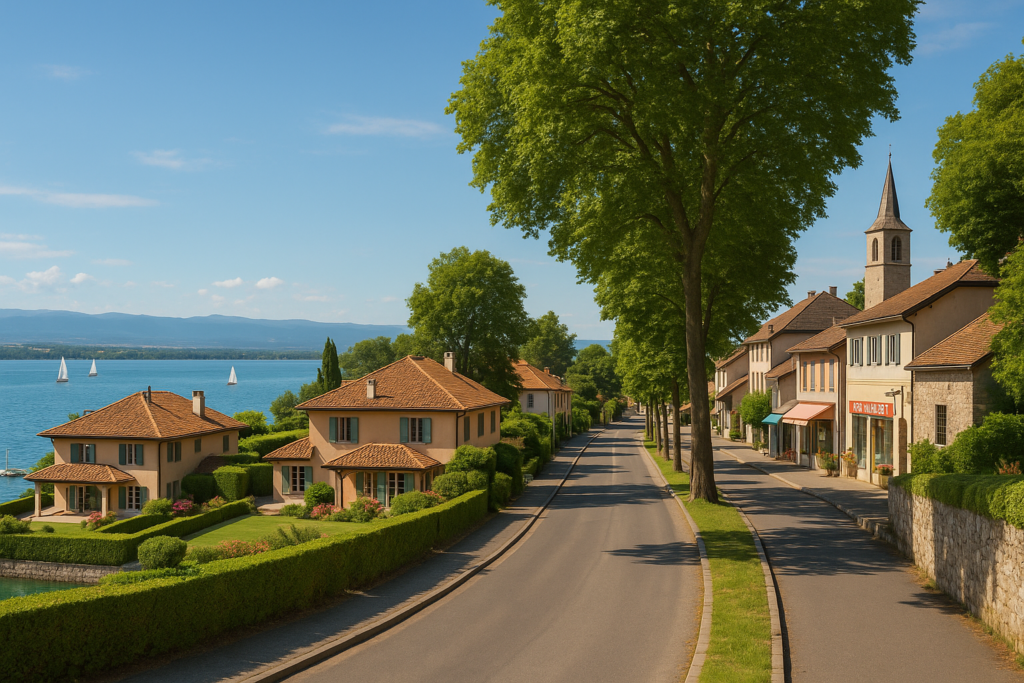
Six kilometres from central Geneva, on the left bank of the lake, Collonge-Bellerive is one of the canton’s most sought-after residential communes — and one of its most distinctive markets: it is here that a share of Geneva’s rare waterfront properties are concentrated. Here is what shapes its prices, who buys here, and where to read the sales that have actually been signed.
What drives prices in Collonge-Bellerive
The local market follows a clear hierarchy. At the top, the lake: properties along the shoreline, with direct access or a private jetty, sit in a category of their own — their value lies in the plot and its absolute rarity, more than in the building itself, and upper-market averages never describe them properly. Next come the villas in residential neighbourhoods, where plot size, views and condition rank prices; then apartments, driven by family demand and proximity to Vésenaz. From one street to the next, the gap can be considerable — this is a market read plot by plot, not by average.
The real prices, live
Between a hillside villa, an apartment in Vésenaz and a lakeside property, no average holds — it is the signed sales that speak. Our Collonge-Bellerive page brings them together for the commune; the transactions map lets you compare it with its neighbours along the chain of lakeside communes; and “what your neighbour sold for” retrieves what was actually agreed around a given address — because la Savonnière is not Saint-Maurice.
A commune of families
Collonge-Bellerive owes its constant demand to a triptych: schools — the state school in Vésenaz and the well-regarded private establishments nearby; the lake in daily life — the Savonnière beach, its shaded lawn and pebble shore; and the countryside six kilometres from the city. Families who settle here stay — which further limits supply and explains the depth of demand for every property correctly positioned.
Vésenaz, the centre of life
At the entrance to the commune, Vésenaz concentrates shops, services and restaurants — a shopping centre with Migros and Manor, boutiques, dining — a genuine village heart on the scale of the Left Bank. This centrality is a property driver in its own right: it lets you live “in the commune” without giving up anything the city offers. It is also here that the “Mirage” development is taking shape, a contemporary residence we are marketing at the heart of the new centre — our current developments page presents the project.
The setting: between lake and countryside
The commune stretches from the shore of Lake Geneva to the agricultural land of the hinterland, with its hamlets — Collonge, Vésenaz, Saint-Maurice — and a still-villagelike scale. The town hall park, the paths towards the lake and the preserved countryside make up a setting that Geneva’s densification has not eroded: this is precisely what demand comes looking for, and what the zoning plan protects. For the buyer, this means structurally limited supply; for the owner, an asset that rarity defends.
Who buys in Collonge-Bellerive
Three profiles dominate: Geneva families seeking space and schools, often already tenants or owners on the Left Bank; international executives based in Switzerland, for whom the commune combines lake, calm and quick access to the centre; and, at the upper end of the market, wealth-driven buyers — family offices, entrepreneurs — drawn by the rare lakeside properties. This depth of demand, across three segments at once, explains the resilience of local prices through every cycle.
What to check before buying here
A commune of villas and lakeside PPE (condominium) units calls for checks that the city centre does not require. They can be done in one morning, free of charge for the most part, and they should be done before making an offer.
The heritage status of the building. The canton’s architectural inventory assesses buildings built before 1985 on a four-tier scale. Its findings have no legal force and are indicative — but protection proposals stem from them. On a 1960s house bought for renovation, this record should be read before any drawings are commissioned. The various regimes and their effects are detailed in our article on Geneva’s built heritage.
The state of the soil. The register of polluted sites is public, the extract per plot can be downloaded free of charge, and it carries official status. On a plot where terracing, an extension or a swimming pool is planned, this is the cheapest check in the file.
Energy performance. Geneva sets a compliance threshold of 125 kWh/m²/year. Beyond the threshold for significant excess, the owner is required to carry out energy renovation works — and this second threshold falls on an already-set schedule: 222 kWh/m²/year until end 2026, 180 from 2027, 153 from 2031. A villa consuming 200 today is outside the obligation tonight and inside it in 2027. This can be negotiated.
Electrics. On a change of owner, an inspection is required if the last one dates back five years, and it is the owner’s responsibility to see to it — not the distributor’s. The safety report should be requested along with the rest of the file: see sale diagnostics.
None of these four checks prevents a purchase. Each puts a figure on something — and in Collonge-Bellerive, where properties are more often negotiated on terms than on the listed price, a buyer who arrives with these answers in hand negotiates on facts while others discuss impressions.
Buying or selling in Collonge-Bellerive
On the buyer’s side, the rule of the local market: the finest properties — waterfront ones foremost — often change hands off-market, before any listing; being known to those who see them come up is the real lever. On the seller’s side, a property in this commune deserves a valuation grounded in real local sales — and, for exceptional properties, the upper-market approach: discretion, a qualified circle, a fair asking price. To place the commune in its wider context, our analysis of the Geneva market gives the overall structure — and technical terms are explained in the glossary.