
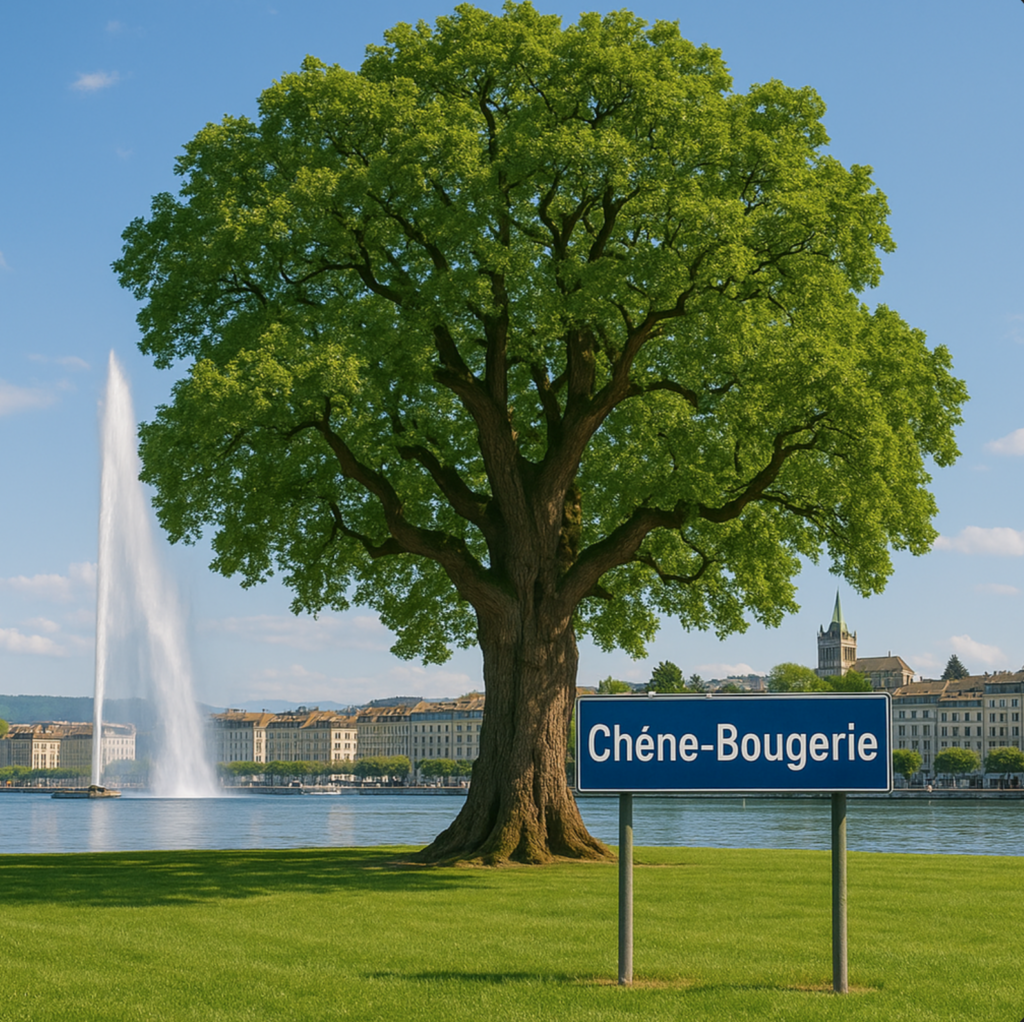
Right on the edge of the city, Chêne-Bougeries is the gateway commune of the Left Bank: the residential address where you keep Geneva ten minutes away without living at its pace. Its market is one of the most sought-after in the canton — driven by an engine that nothing weakens: families and their schools. Here is its structure, area by area.
One commune, several markets
Chêne-Bougeries is not homogeneous: La Gradelle and its residential developments from the 1960s-70s, sought after by families for their volumes and parks; Grange-Canal and Malagnou, in direct continuity with the smart urban neighbourhoods, where you find high-standing older properties; the surroundings of La Seymaz and the village centre, on the greener side with villas. From one area to another, the typology changes — high-standing flats here, family villas and homes on wooded plots there — and prices change with it: the commune must be read area by area, never as an average.
The engine: families and schools
Demand in Chêne-Bougeries rests on a remarkably stable foundation: the concentration of renowned private and international schools in the commune and at its immediate doorstep. For families — Genevan and international alike — living in Chêne-Bougeries means having the school within cycling distance; this demand renews itself with every school year, in every market cycle. On top of this come efficient public transport links to the centre — trams and buses running continuously — and a fabric of shops and services that makes the commune self-sufficient day to day: for many families, a car becomes optional rather than necessary. This combination — schools, greenery, centrality — explains why a correctly positioned family property finds a buyer within weeks, in every market cycle.
What drives prices
Four factors rank the market: the plot for villas — size, planting, privacy; proximity to schools, which commands a premium; character — historic homes and renovated older properties keep a consistent premium; and for flats, the floor, outdoor space and the actual weighted floor area. The top of the local market — the large properties of Grange-Canal or the village — joins the Geneva luxury segment and its own rules.
A commune that sells mostly in flats
The image of Chêne-Bougeries is one of villas and parks. The reality of the deeds is more nuanced: among the sales recorded this year, flats clearly outnumber houses — La Gradelle, Grange-Canal and Malagnou carry significant weight in volume, while villas in the village and along the Seymaz change hands more rarely and at higher prices. A villa seller therefore has few recent comparables, and this is precisely why the communal average is of no use to them: their reference point is the small number of sales within their own segment. The up-to-date count is available on our commune page.
At the heart of the Trois-Chêne
Chêne-Bougeries forms, together with Chêne-Bourg and Thônex, the Trois-Chêne group — the urban seam between Geneva and the countryside. This position gives it two faces: on the city side, trams and roads running to the centre in minutes; on the east side, the transition towards the Seymaz and the villa communes. For the market, this seam is a strength: the commune captures both urban demand — those leaving the city without wanting to lose it — and classic residential demand from families. Few Geneva communes combine two such buyer pools; this is one of the reasons for the remarkable liquidity of its market, in every cycle.
Conches: the area statistics do not see
Here is a blind spot that few sellers are aware of, and which distorts every comparison made in good faith.
The land registry publishes its transactions by commune and by cadastral section — never by neighbourhood. Yet Conches, with its postcode 1231, belongs administratively to Chêne-Bougeries. Its sales therefore never appear under the name “Conches”: they are recorded under Chêne-Bougeries, mixed in with those of La Gradelle, Grange-Canal and the village centre.
There are two consequences, one for the seller and one for the buyer. An owner in Conches searching for “the price per square metre in Conches” finds nothing, or finds listing averages unrelated to actual deeds; if they fall back on the Chêne-Bougeries average, they are comparing their property to a set it does not belong to. A buyer, symmetrically, cannot isolate the micro-market they are targeting from the public statistics.
We tackled the problem through the only door available: the property’s postcode, readable in the text of the published deed. This code distinguishes Conches (1231) from Chêne-Bougeries (1224 and 1225). Each sale is therefore counted twice, deliberately — once for its neighbourhood, once for its commune: a neighbourhood is within its commune, it is not subtracted from it.
The result can be seen on our commune page, where Conches sales finally appear under their own name, and on the transactions map. The same mechanism affects sales in Champel, recorded under Genève-Plainpalais, and in Vésenaz, recorded under Collonge-Bellerive. If you are selling in one of these three areas, the communal average is not your reference point.
Real prices, live
A sale in La Gradelle tells you nothing about Grange-Canal, and the village centre plays yet another tune. Our Chêne-Bougeries page brings together the commune’s recorded sales; the transactions map places it among the Trois-Chêne and the Left Bank; and “how much did your neighbour sell for” looks at signed sales around a specific address. It is on these sales — never on listings — that a price is built.
Buying or selling in Chêne-Bougeries
On the buyer’s side, competition is structural: well-located family properties sell fast, often before they are advertised — confirmed financing and a precise search area make the difference. On the seller’s side, deep demand does not exempt you from method: an appraisal grounded in sales from the micro-area, careful preparation, and the right asking price. To place the commune within the wider Geneva picture, our market analysis provides the framework — technical terms are in the glossary.