
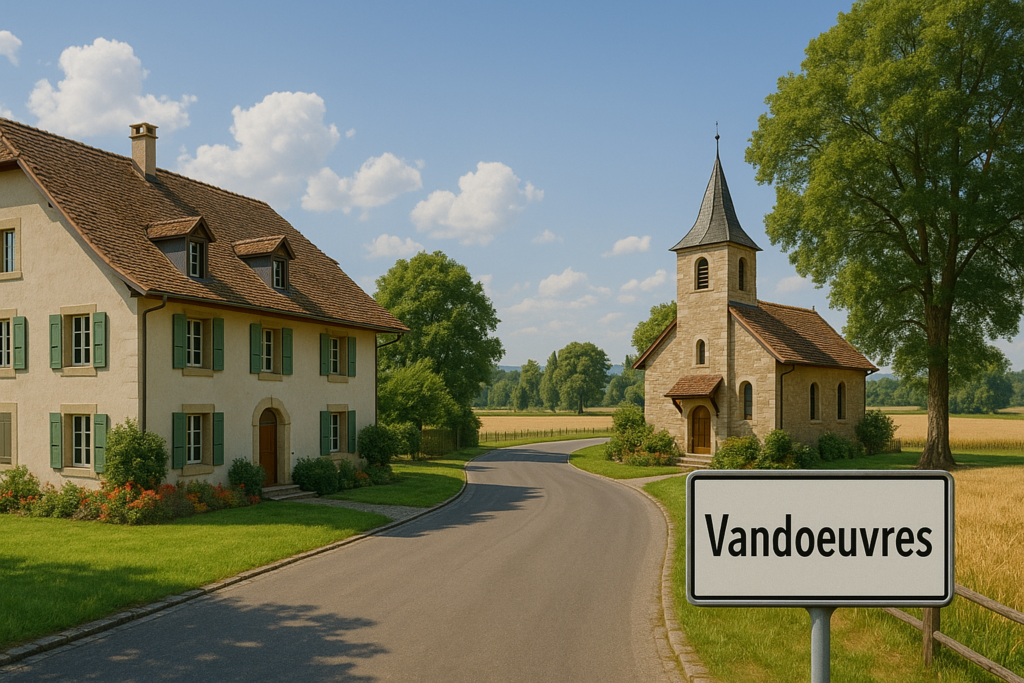
Four and a half kilometres from central Geneva, Vandœuvres is a precious paradox: a commune where nearly two-thirds of the territory remains agricultural, ten minutes from the lakefront. This patrician countryside — estates, century-old oaks, hamlets — is one of the most sought-after addresses in the canton, and its market follows rules very much its own. Here they are.
The countryside as DNA
Across 443 hectares, Vandœuvres has preserved what the canton has lost almost everywhere else: vast agricultural spaces, rows of century-old oaks, large landscaped estates, and hamlets — Chougny, Crête, Pressy — that punctuate the territory without densifying it. The golf course, at the edge of the commune, completes this way of life. This landscape is not mere scenery: it is the zoning that protects it, and that zoning is what creates the scarcity — and therefore the value — of every buildable plot.
A market of villas — almost exclusively
Vandœuvres is the market for the family villa and the property of character: no urban centre, very few flats, no apartment blocks. The hierarchy plays out through the plot — surface area, planting, privacy, remaining building rights —, through the view — the Alps or the lake depending on the slope’s orientation —, and through the building itself, from flawless contemporary design to a residence awaiting reinvention. The top of the local market joins the Geneva luxury segment; new-build supply, meanwhile, is limited to a few rare projects on released plots — each one an event in itself.
Living in Vandœuvres day to day
The commune cultivates a discreet village life — a communal school, community activities, riding schools and bridle paths, walking routes between the estates — and relies on its neighbours for the rest: the shops and services of Chêne-Bougeries and Vésenaz are just minutes away, international private schools a quarter of an hour, and the city ten minutes by car. It is a deliberate lifestyle choice: that of fully lived-in countryside, without compromising on access — the rarest geographical luxury in the canton.
What the records say, and what surprises
Vandœuvres is a commune of villas: that is true of its landscape, its zoning plan and its identity. But if you look at what actually sold this year at the land registry, the picture is reversed — flats overwhelm houses in volume, by a wide margin.
The explanation is not a change in the nature of the commune: it comes down to three addresses. A few condominium (PPE) operations — one building on chemin des Hauts-Crêts alone accounts for some thirty units — are enough to dominate the annual count in a commune where villas change hands only sparingly. A year in Vandœuvres means a few dozen units across two or three schemes, and a handful of properties.
Three practical consequences, and they matter:
- A “communal average” means nothing here. It mixes new units in condominium ownership with properties on large plots — two markets with different buyers, different prices per square metre, and different timeframes;
- a villa seller has very few recent comparables. Their reference point is not the commune: it is the small number of equivalent properties sold over several years, in Vandœuvres and in neighbouring communes of the same nature;
- a villa buyer must expect to wait. What is not for sale cannot be found in listings: it must be prepared for, and seized when it appears — often before it is listed.
One last point, counter-intuitive but useful: in a commune where volume depends on two or three schemes, an “active” year does not mean a liquid market. The number of transactions can double without a single additional villa changing hands. This is why we count sales here by segment, never in bulk.
The detail of sales, updated as the registry publishes, is available on our Vandœuvres page — with, for each one, its address and date. It is by reading them one by one, rather than averaging them, that a property can be properly placed.
The real prices, live
Few transactions, incomparable properties: averages mislead here more than elsewhere. Our Vandœuvres page archives the commune’s registered sales; the transactions map offers a cantonal perspective; and “how much did your neighbour sell for” finds the signatures on a given street. Here, valuation is done plot by plot — land on one side, construction on the other — as explained in our valuation method.
Who buys in Vandœuvres
Established families — Genevan and international — who want space, nearby schools and the city ten minutes away; wealth-holding profiles for whom a Vandœuvres estate is a generational asset; and neighbours themselves — in Vandœuvres, many plots are passed on or exchanged without ever appearing in a listing, within a circle well known to industry professionals. Compared with Chêne-Bougeries and its schools, or Cologny by the lake, Vandœuvres plays the role of absolute countryside — same standing, different promise.
An estate passed down more than sold
The most telling statistic in Vandœuvres is not a price: it is the length of ownership. Estates here are passed down through generations, plots are rarely divided, and zoning discourages any opportunistic densification. For the market, this means that a property put up for sale is an event — and that its value depends as much on what it is as on the fact that no other will follow behind it. This is the reasoning of wealth-holding buyers, not opportunists: in Vandœuvres, one buys a horizon of decades.
Selling in Vandœuvres
A Vandœuvres property sells through its plot as much as through its walls: an on-site valuation weighs every component, and for exceptional estates, the top-of-market method is essential — discretion, a qualified circle, a fair entry price. The overall framework is set out in our analysis of the Geneva market — and technical terms in the glossary.