
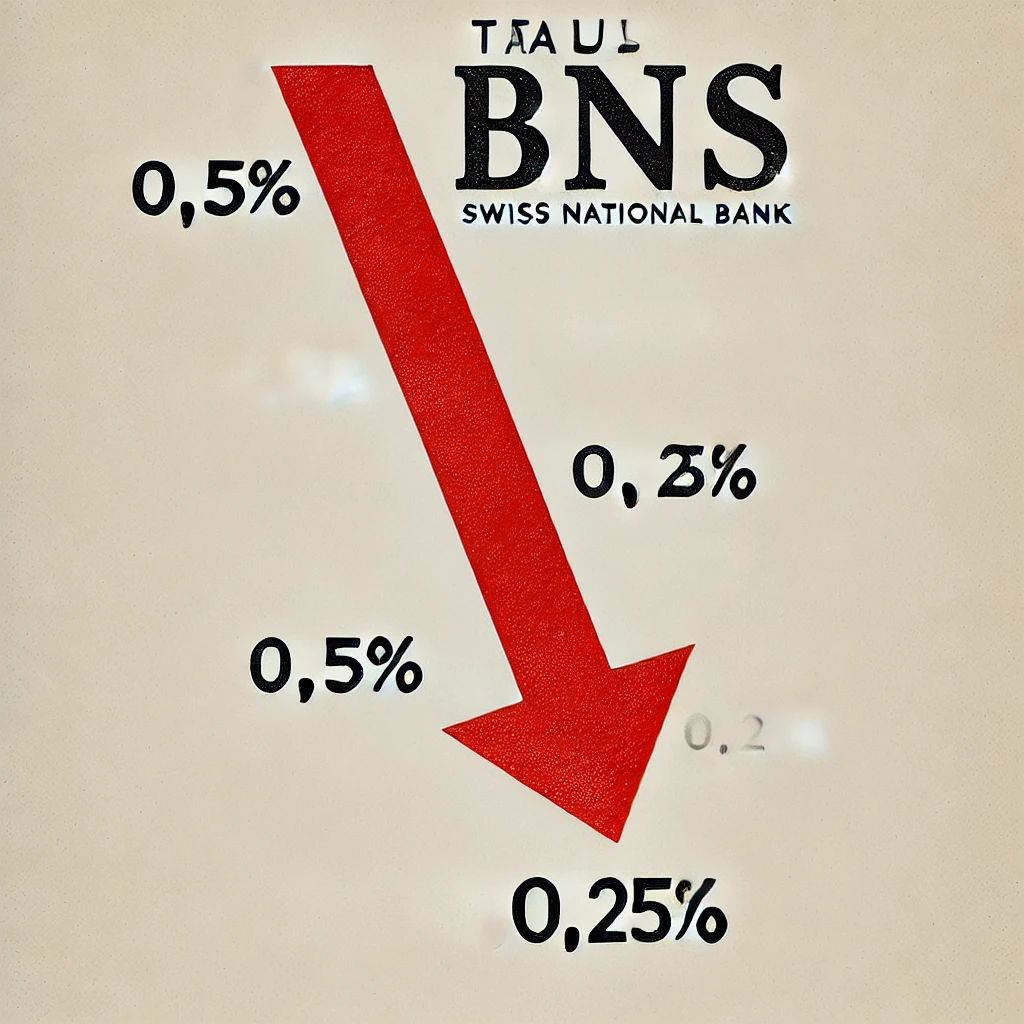
“Rates are at rock bottom, so I’ll be able to borrow more.” This is the most common mistake among Geneva buyers — and it costs weeks of poorly calibrated searching. A policy rate at 0% eases the monthly bill, but does not move by a single franc the amount your bank will agree to lend. Here is the actual chain, from the Swiss National Bank’s rate to your financing file.
Where the policy rate stands
The Swiss National Bank is holding its policy rate at 0%, a level confirmed at its monetary policy assessment on 18 June 2026. The SNB has never ruled out going lower should the economic situation require it, as it has reiterated on several occasions since returning to zero. We deliberately do not publish a table of mortgage rates: these figures move from week to week, and a fixed grid in an article becomes misleading within days. For an up-to-date figure, only your bank — or a mortgage broker — is authoritative.
From the policy rate to your mortgage: what carries through, what doesn’t
The policy rate is not your mortgage rate. Between the two lie two very different paths.
SARON mortgages track monetary policy closely: their rate is made up of SARON, which hovers around the policy rate, plus your bank’s margin. When the SNB cuts, these financings fall almost mechanically — and rise just as quickly the day it hikes.
Fixed rates, on the other hand, do not depend on the policy rate but on capital-market expectations over the chosen horizon. This is why a ten-year fixed rate can rise even as the SNB has just cut: it does not express today’s situation, but what the market imagines for the coming decade. Conflating the two leads people to believe that an SNB decision automatically “delivers” a better fixed rate. It does not.
Why a 0% rate doesn’t increase your borrowing capacity
This is the point almost nobody anticipates. To grant a loan, a Swiss bank does not calculate your charges at today’s rate: it calculates them at a theoretical rate of around 5%, well above the market, to which it adds amortisation and flat-rate maintenance costs. The total must not exceed roughly a third of your income. This prudential rule, stemming from bank self-regulation, exists precisely so that credit does not run away when rates are low.
The consequence is clear-cut: whether the market rate is at 1% or 0.5%, the maximum amount the bank will grant you remains the same. Low rates improve your monthly comfort, not your ceiling. What shifts this ceiling is your income, your equity and your existing commitments — never the SNB’s decision of the day. We detail this calculation, with a worked example, in our article on financial capacity, and our mortgage calculator applies the same rule in a few seconds.
What low rates really change
For a buyer: the monthly instalment, and therefore the cost of ownership over time — a half-point gap on a CHF 1 million financing represents thousands of francs a year. Low rates also make buying more competitive against renting, which widens the pool of candidates for each property.
For a seller: more solvent buyers on the other side of the table, and above all files that go through faster. The effect shows up first in selling timeframes, less in the advertised price: a low rate creates no additional properties for sale, and in Geneva scarcity remains the dominant factor, as we explain for the Left Bank market.
For an existing owner: this is the time to look at your renewal date. A renewal is ideally prepared in the months before the term, by putting several banks in competition — the gap between your bank’s unsolicited offer and the best rate obtained elsewhere is rarely a matter of a few cents.
The third rate, the one that decides rents
A third rate circulates in property conversations, and it is regularly confused with the Swiss National Bank’s rate: the reference mortgage rate. It concerns neither your loan nor your purchasing capacity — it governs rents, and follows an entirely different logic.
It is published by the Federal Housing Office four times a year — in March, June, September and December. It is based on banks’ average mortgage rate and always rounded to the nearest quarter of a percentage point. It currently stands at 1.25%, a level in effect since 2 September 2025 and confirmed on 2 June 2026.
Its effect is mechanical and quantified: each quarter-point increase opens the possibility of a 3% rent increase, and each quarter-point decrease allows the tenant to request a 2.91% reduction.
This is why a 0% policy rate does not bring Geneva rents down. The reference rate incorporates long-term fixed-rate mortgages still on banks’ books: it only moves slowly, whether upward or downward. Between the SNB’s decision and an apartment’s rent, there are several years of lag — and a rate that only moves in steps of twenty-five hundredths.
For a landlord, the practical consequence is to watch the four annual publications rather than the SNB’s announcements. For a buyer purchasing an occupied property, it is the figure that quantifies future yield: an in-place rent set against a higher reference rate is a rent exposed to a reduction request.
Fixed or SARON: the question that remains
There is no universal answer, and be wary of anyone who gives you one. SARON has historically been cheaper on average, but exposes you to a rise without notice: it assumes a budget able to absorb an increase. A fixed rate buys peace of mind — you know your charge for ten years — and is paid for through a premium, plus a penalty in the event of early repayment. The right choice depends on your holding horizon, your budgetary room for manoeuvre and your risk tolerance, not on the level of the policy rate at the moment of signing.
A Geneva-specific point too often overlooked: if you sell and buy at the same time, the structure of your current financing weighs as much as its rate — a poorly anticipated exit penalty can absorb the gain from a better rate.
Where to start
In order: know your actual capacity with the calculator, gauge the value of the property in question with our online estimate, then discuss financing with a professional once these two benchmarks are set. Rates are one parameter in the calculation, never the starting point. And if you are preparing a first purchase, our guide becoming a homeowner covers all the conditions, including equity and LPP.